
How to Search Criminal Dockets
Start with the court level. Felony indictments and felony proceedings belong with the Jefferson County District Clerk. Class A and B misdemeanors heard in the county courts at law belong with the County Clerk. A municipal or justice-court citation does not move into either index merely because the event happened in Jefferson County. Keep the defendant's full name, an indictment or cause number, and an estimated filing year close at hand.
The current criminal index is a useful first stop for district criminal matters. The older historical felony index searches by year, indictment number, and defendant and generally covers 1981 through 2022. An index match points to the case. It does not supply every filed paper or prove the final outcome.
- Identify felony, county misdemeanor, JP, or municipal jurisdiction.
- Search the matching index by name, year, or known case number.
- Compare identifiers and court assignment before relying on a match.
- Read settings, motions, plea entries, judgment, and sentence separately.
- Ask the responsible clerk for the docket sheet or a certified order.
Jefferson Criminal Index Generations
Jefferson County criminal docket research spans more than one online system. The static historical index generally ends in 2022. A separate current criminal index, created or updated July 1, 2026, offers newer year access and reaches back through older years with gaps. The county also links an Odyssey public portal. Its documented access path requires registration, sign-in, and sometimes county approval.
That split matters. A failed search in one interface does not prove that no Jefferson County criminal case exists. Try the correct date-era index, then contact the District Clerk at 409-835-8580 or districtclerk@jeffersoncountytx.gov. In-person help and public-terminal inquiry are available at 1085 Pearl Street in Beaumont. A narrow request naming the cause number and exact paper is easier to route than a broad request for everything.
The official current-index view shows the county's newer criminal search entry point.
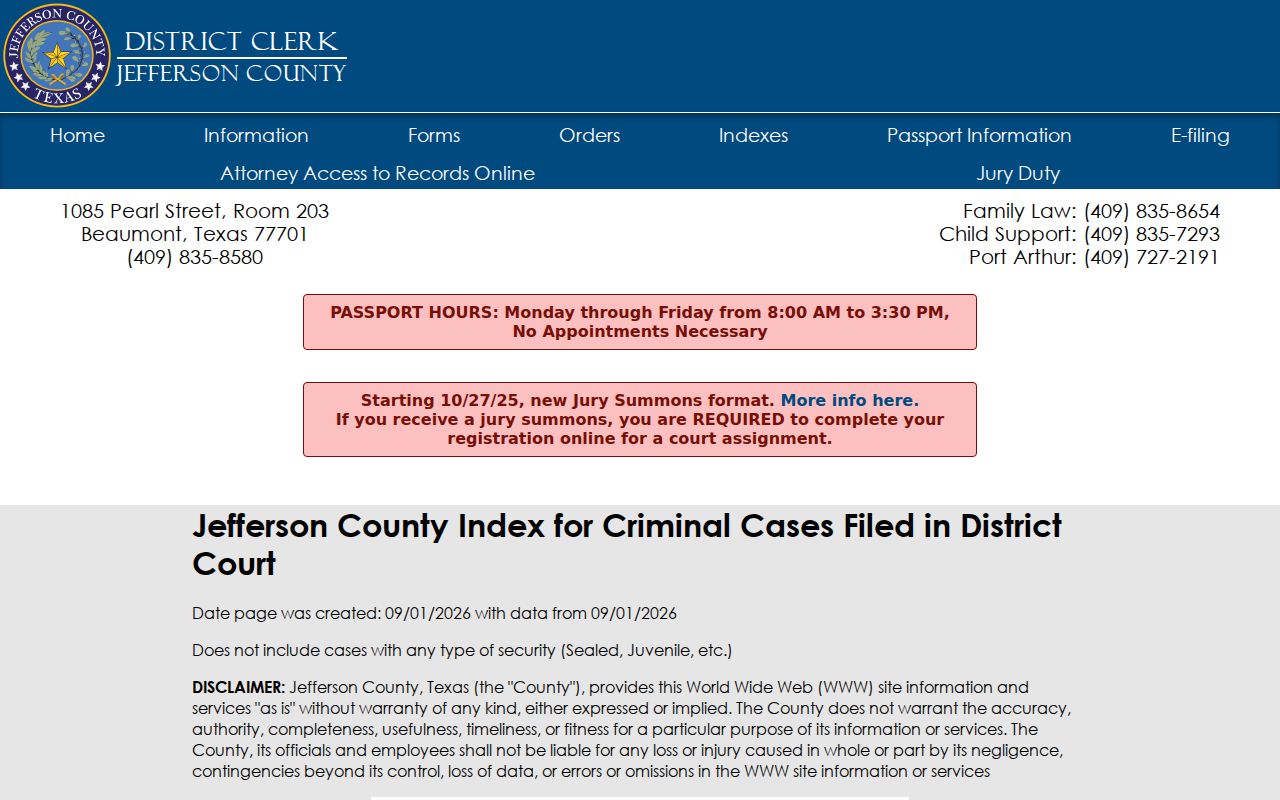
The image helps distinguish the current index from the older year-based pages, which remain relevant for earlier filings.
What a Criminal Docket Shows
A Jefferson County criminal docket is a chronological register. It can identify the court, cause number, charge, filing date, counsel, bond activity, hearing settings, motions, orders, plea events, judgment, sentence, costs, and appeal notices. Entries are short labels, so the underlying document often carries the fact that matters most. A setting does not prove that the event occurred, and a plea setting does not prove that a plea was entered.
| Cause or indictment number | The local identifier used to retrieve the docket and request papers. |
|---|---|
| Charge | The alleged offense and degree, not a finding of guilt. |
| Setting | Arraignment, announcement, plea, motion, pretrial, or trial date. |
| Bond entry | Bond conditions, status, or a related order when recorded. |
| Disposition | The recorded result, which should be checked against the signed judgment or dismissal order. |
When certainty matters, request the indictment, judgment, sentence, dismissal order, or appellate filing by name. The clerk's financial ledger is also distinct from the hearing calendar.
Jefferson Misdemeanor Docket Labels
The county courts at law publish criminal setting labels such as initial appearance, jail run or arraignment, announcement, plea, MTRP, pretrial motion, jury trial, and reset. MTRP means motion to revoke probation. An announcement tells the court whether a case is ready or needs further action. A reset moves the next setting; it does not erase the case.
- Initial appearance
- An early appearance when the court addresses status and next steps.
- Announcement
- A readiness setting rather than the trial itself.
- MTRP
- A motion asking the court to revoke probation.
- Reset
- A new setting date entered after the prior date changes.
The County Court at Law No. 2 page illustrates how one Jefferson County court posts settings and docket links.
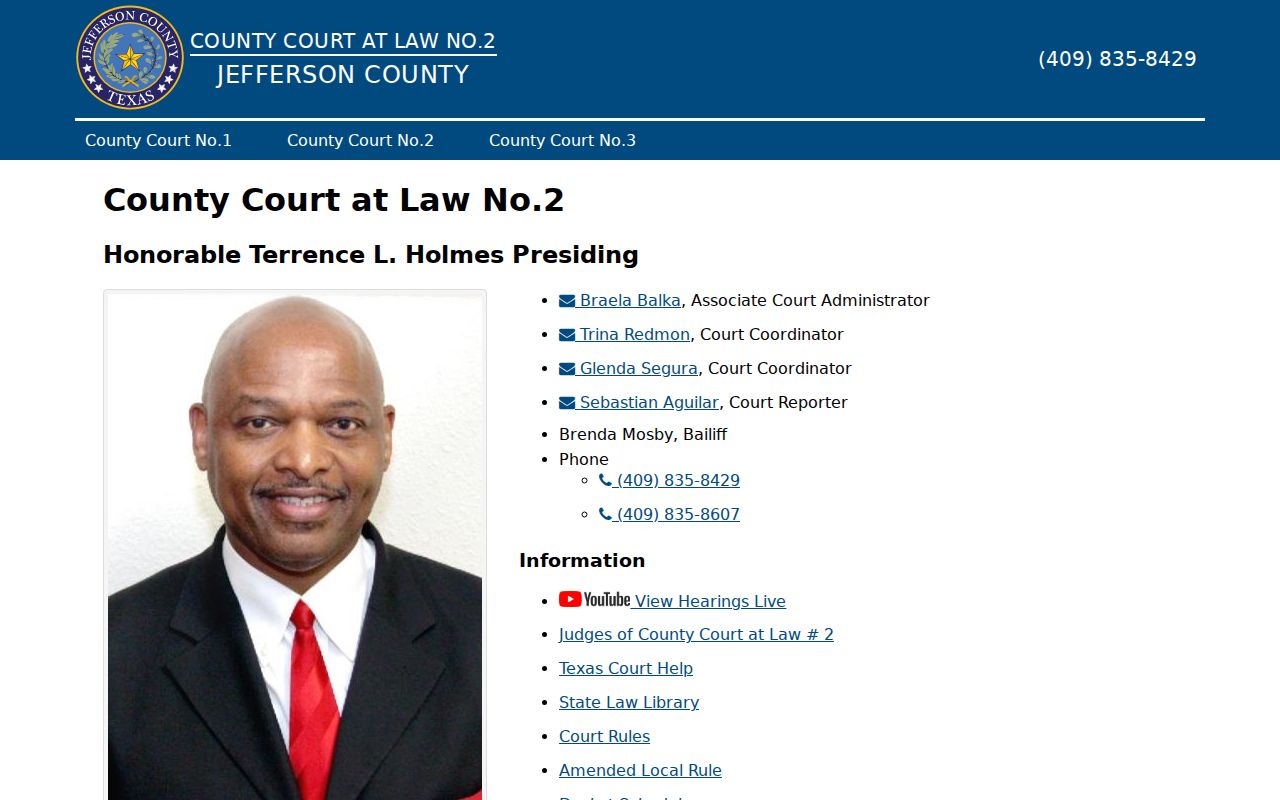
The posted court page is a routing and calendar tool. The clerk's docket and signed order remain the record of what happened.
Stages on a Criminal Docket
A felony docket may begin with grand-jury and indictment work kept by the District Clerk. Later entries can concern warrants, commitment, counsel, bond, subpoenas, discovery-related filings, motions, and settings. The exact path varies. Some cases end by dismissal or plea, while others proceed to trial, judgment, sentence, probation work, or appeal.
Docket flow: Filing → Arraignment → Pretrial → Plea or Trial → Disposition → Sentencing
Read the sequence, not one isolated row. A motion is a request until the court rules. An appellate notice shows that review was sought, not how the appeal ended. If a disposition label seems unclear, pair the docket entry with the signed order and confirm it through the Jefferson County clerk that holds the file.
Jefferson Felony Court Routes
Criminal District Court and the 252nd Criminal District Court are the named Jefferson County felony courts highlighted in county resources. Their pages supply hearing links, docket materials, court staff contacts, and bond-condition information. The District Clerk remains the records custodian for district felony dockets. Public observation links may help a person follow a listed proceeding, but the county forbids recording or rebroadcasting those streams.
Use the court stream as observation only. It is not a certified record, and it does not replace the docket sheet, judgment, or sentence held by the clerk.
Drug Court and drug-case phone labels in the county directory are routing clues, not proof that a matter sits on a separate public index. Ask which court and cause number control the file before sending a request.
Which Court Holds Criminal Dockets
Jefferson County district criminal courts hear felonies, and the District Clerk keeps those records. County Courts at Law Nos. 1, 2, and 3 hear county misdemeanors, with records held through the County Clerk. Justice courts and the municipal courts in Beaumont, Port Arthur, Nederland, Groves, and Port Neches handle their own fine-only Class C and traffic files.
| Matter | First custodian | Search path |
|---|---|---|
| Felony | District Clerk | Current or historical criminal index, Odyssey, clerk request |
| County misdemeanor | County Clerk | Odyssey or County Clerk request |
| Class C or citation | Issuing JP or municipal court | Court-specific portal, phone, or counter |
The County Clerk's $10 background-search form is narrower than a full criminal docket search. It covers Class A and B misdemeanors filed by the District Attorney from 1982 forward and excludes JP cases, tickets, and police citations. Its name should not be read as statewide coverage.
Jefferson Criminal Clerk Channels
Online search is only one access route. Contact the District Clerk by phone or email for a felony docket, visit the clerk or public terminal at 1085 Pearl Street, or ask whether a narrow written request may be sent by mail, fax, email, or dropbox for the exact record. County misdemeanor requests should go to the County Clerk at 409-835-8475. The re:SearchTX system offers a registered statewide layer for participating courts, cases, filings, text, and hearings, but participation and document coverage must be checked live.
For judicial administrative records, follow Texas Rule of Judicial Administration 12 and the named records custodian. The county's public-information process is another route for county-held administrative records. It does not override sealing orders or transform a restricted case record into a public one.
Note: Ask the clerk which channel fits the exact docket or document before mailing payment or sensitive identifiers.
Public Access and Sealed Criminal Dockets
Many Jefferson County criminal docket entries are public, but access is not absolute. The current criminal index expressly omits security-restricted matters, including sealed and juvenile records. Expunction and nondisclosure procedures can also limit what appears. Family identifiers, protected addresses, victim information, and other confidential data may be redacted even when a public docket entry remains.
Key rules:
Texas Rule of Judicial Administration 12 sets a custodian-based request process for judicial records.
Jefferson County public-information procedures explain how to route requests for county administrative records.
A sealing order or confidentiality law controls over a general public request. Ask for a public docket sheet or redacted copy when full access is unavailable.
Do not infer facts from a missing online result. Verify the correct court, date range, spelling, and system. Then ask the clerk whether the matter is absent, delayed, sealed, juvenile, or otherwise restricted.
Jefferson Criminal Record Requests
A focused request can bridge the gap between an index and the evidence behind it. Ask for the docket sheet plus the exact indictment, bond order, judgment, sentence, dismissal order, or appellate notice needed. If the question concerns fines, fees, or costs, request the current financial statement rather than reading a balance from a calendar.
For older matters, give the defendant name, approximate year, and indictment number if known. For a newer case, give the cause number and assigned court. State whether a plain or certified copy is needed. The clerk can explain access and copy steps but cannot give legal advice.